

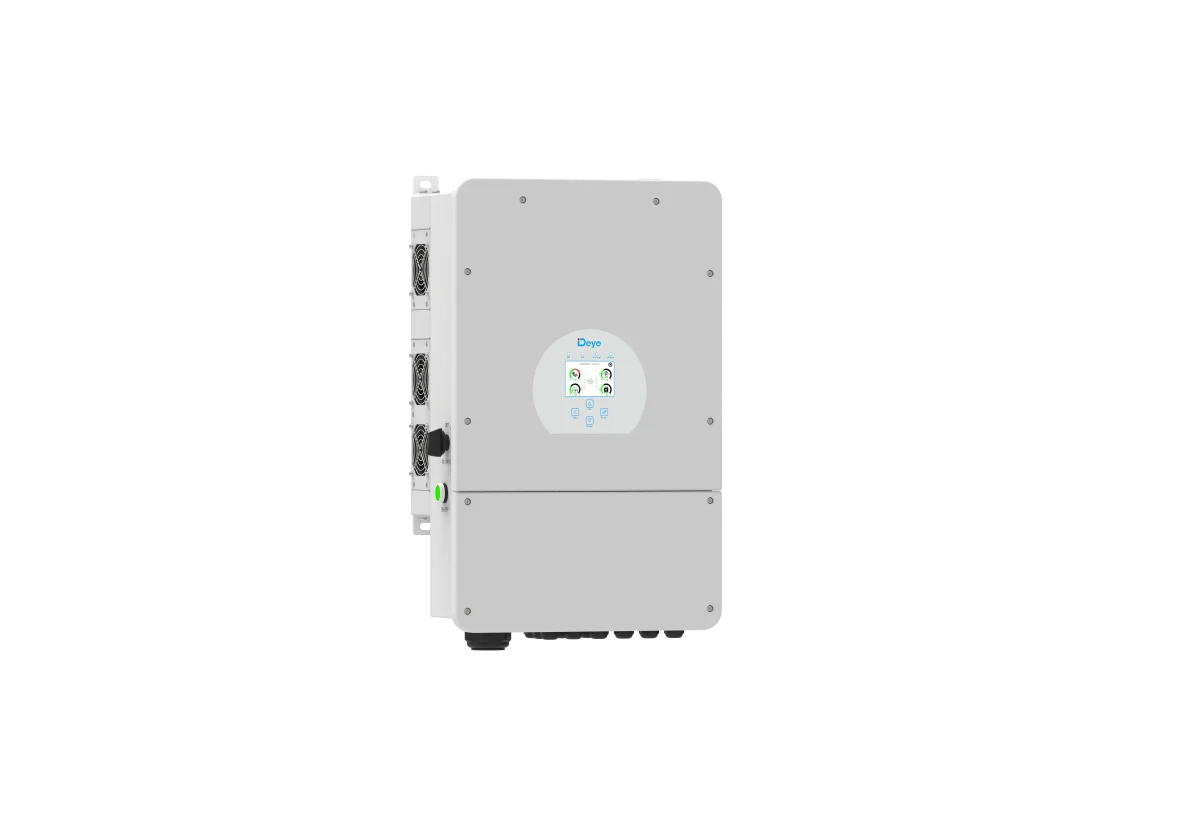
Why 8KVA Is Becoming Popular in Kenya
Rising Residential and Commercial Energy Demands
If you look at how homes and small businesses in Kenya operate today compared to five years ago, the difference is massive. Larger refrigerators, borehole pumps, electric fences, CCTV systems, home offices, washing machines, microwaves, air fryers — the modern Kenyan property consumes far more electricity than before. A 3kVA or 5kVA system that worked years ago now feels undersized for many households.
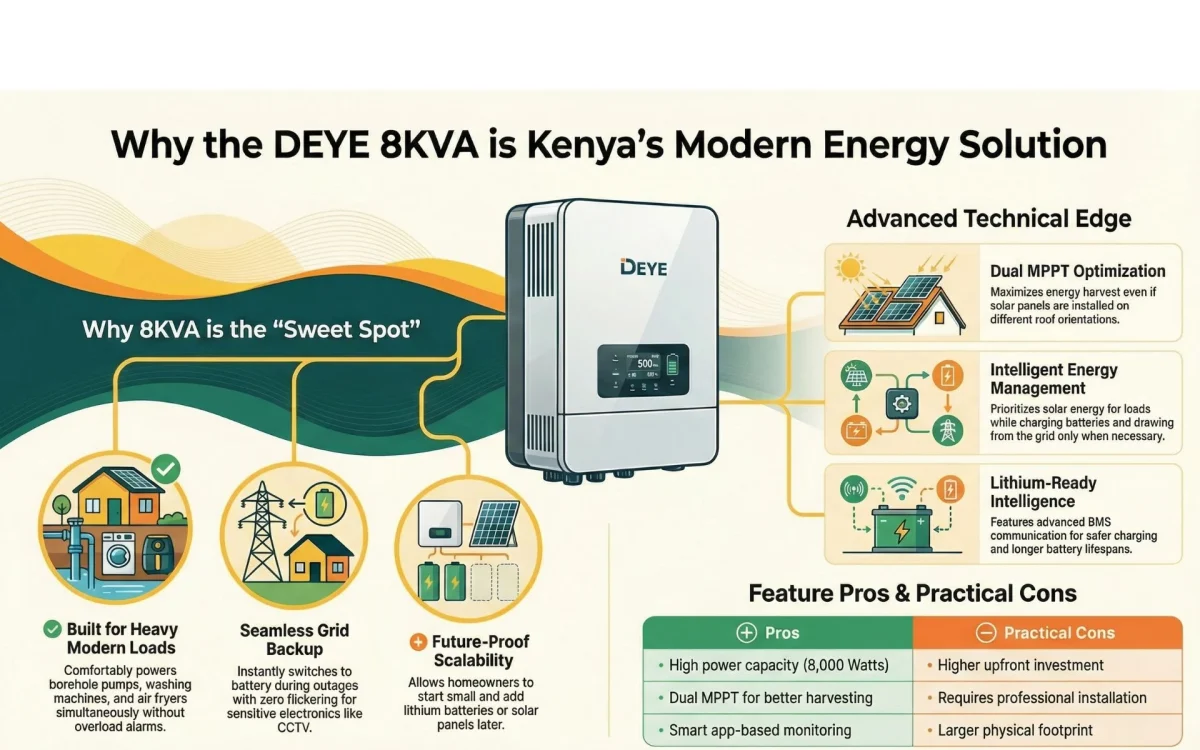
That’s exactly why 8KVA hybrid inverters are gaining popularity. They offer a comfortable buffer for high-load appliances while still remaining affordable compared to larger commercial-grade systems. Instead of constantly worrying about overload alarms or switching appliances off to avoid tripping the inverter, an 8KVA setup gives breathing room. It allows simultaneous operation of multiple heavy loads without stress. For growing homes, farms, and small businesses, this capacity hits the sweet spot.
Need for Reliable Backup and Solar Independence
Grid reliability in many parts of Kenya still varies. Power outages, voltage fluctuations, and maintenance interruptions are common realities. Businesses lose productivity. Homes lose comfort. Refrigeration and security systems become vulnerable. A properly sized 8KVA hybrid inverter eliminates that anxiety by automatically switching to battery power during outages.
Hybrid technology also enables energy independence. During sunny hours, solar panels power loads and charge batteries. At night, batteries take over before drawing from the grid. It’s like having a silent, intelligent energy manager operating in the background 24/7.
www.happysolar.co.ke || www.solarpower.co.ke
Call | Text | WhatsApp: +254 741 163020
Overview of DEYE as a Solar Brand
Global Reputation and Technology
Deye has steadily built a strong international reputation in the solar industry. The brand focuses on hybrid inverters designed for flexibility, smart monitoring, and lithium battery integration. Their products are widely used in residential and light commercial installations worldwide, making them a serious competitor to premium European brands.
One reason buyers gravitate toward DEYE is the balance between affordability and advanced features. Many competing brands either offer limited hybrid functionality or come at a significantly higher price point. DEYE bridges that gap by offering robust performance, multiple MPPT inputs, intelligent battery communication, and app-based monitoring — all in one unit.
Why DEYE Is Trusted in Kenya
In Kenya, DEYE has gained traction among installers and solar companies due to its compatibility with locally available lithium batteries and its ability to handle grid instability. Voltage fluctuations are not uncommon in some regions, and inverters must be resilient enough to withstand those changes without frequent faults.
Another advantage is scalability. DEYE hybrid inverters allow expansion of battery capacity and solar array size without replacing the entire system. For Kenyan homeowners planning phased solar investments, that flexibility is extremely valuable.
www.happysolar.co.ke || www.solarpower.co.ke
Call | Text | WhatsApp: +254 741 163020
Key Features of the DEYE 8KVA Hybrid Inverter
True Hybrid Functionality
The DEYE 8KVA is not just a backup inverter. It is a true hybrid system designed to intelligently combine solar panels, lithium batteries, and grid power. During peak sunlight, it prioritizes solar energy to power loads while charging batteries. If solar production exceeds consumption, the excess can be stored or exported depending on configuration.
When the grid fails, the inverter switches instantly to battery mode. The transition is seamless, meaning there’s no flickering of lights or interruption to sensitive electronics. For businesses relying on internet connectivity and POS systems, this uninterrupted power supply is critical.
Dual MPPT Solar Optimization
One standout feature of the DEYE 8KVA inverter is its dual MPPT (Maximum Power Point Tracking) inputs. This allows the inverter to optimize solar panel output even if panels are installed on different roof angles or orientations. In Kenyan homes where roof space may face east and west, this feature significantly improves energy harvest.
By maximizing solar efficiency throughout the day, homeowners reduce reliance on the grid and shorten payback periods. It’s not just about installing panels; it’s about extracting maximum performance from them.
www.happysolar.co.ke || www.solarpower.co.ke
Call | Text | WhatsApp: +254 741 163020
Technical Specifications Explained
Power Output and Load Capacity
An 8KVA inverter typically delivers around 8,000 watts of power, making it suitable for large homes, small offices, retail shops, and farms. This capacity comfortably supports refrigerators, freezers, water pumps, electric fences, CCTV systems, and heavy kitchen appliances simultaneously.
The inverter also handles surge loads efficiently. Appliances like pumps and compressors require higher startup current than running current. The DEYE 8KVA is designed to accommodate these surges without triggering overload protection unnecessarily. That stability improves system reliability and extends appliance lifespan.
Battery Compatibility and Expansion
The DEYE 8KVA supports lithium-ion batteries with advanced BMS communication. This direct communication ensures safe charging, controlled discharge, and balanced cell management. Lithium batteries are preferred in Kenya due to longer lifespan and deeper discharge capabilities compared to traditional lead-acid options.
Another key benefit is expandability. Homeowners can start with a moderate battery bank and add more storage later. This staged investment approach makes solar more financially accessible.
www.happysolar.co.ke || www.solarpower.co.ke
Call | Text | WhatsApp: +254 741 163020
Installation Considerations in Kenya
Proper System Sizing
Before purchasing an 8KVA inverter, load analysis is essential. Oversizing leads to unnecessary costs, while undersizing causes performance issues. A professional installer calculates peak load demand, daily consumption, and battery backup requirements before recommending system components.
Panel sizing must also match inverter input specifications. Installing too few panels underutilizes the inverter, while installing too many may exceed voltage limits. Proper design ensures maximum efficiency and longevity.
Professional Installation Requirements
Hybrid systems require proper grounding, DC isolators, AC breakers, and surge protection. Incorrect installation can reduce efficiency or pose safety risks. Choosing an experienced solar company ensures proper cable sizing, correct configuration settings, and reliable commissioning.
Professional installers also set charging priorities, time-of-use settings, and monitoring integration according to client needs.
www.happysolar.co.ke || www.solarpower.co.ke
Call | Text | WhatsApp: +254 741 163020
Performance in Kenyan Climate
Handling Heat and Dust
Kenyan climate conditions can be harsh, especially in hot and dusty regions. The DEYE 8KVA inverter is designed with protective mechanisms against overheating and environmental stress. Proper ventilation during installation enhances durability.
High temperatures can affect electronic equipment, but quality hybrid inverters include built-in thermal management systems to maintain stable operation.
Managing Grid Fluctuations
Voltage instability can damage sensitive appliances. The DEYE hybrid inverter stabilizes output power, protecting connected loads. This feature is particularly valuable in regions experiencing frequent voltage swings.
By combining surge protection and intelligent switching, the system maintains consistent performance even during grid irregularities.
www.happysolar.co.ke || www.solarpower.co.ke
Call | Text | WhatsApp: +254 741 163020
Cost of DEYE 8KVA Hybrid Inverter in Kenya
Equipment Pricing Breakdown
The total cost of an 8KVA hybrid system includes:
- The inverter unit
- Solar panels
- Lithium battery bank
- Mounting structures
- Installation and commissioning
Pricing varies depending on battery capacity and panel size. While the upfront cost may appear significant, it should be viewed as infrastructure investment rather than monthly expense.
Return on Investment (ROI)
Solar reduces grid dependency significantly, especially during sunny seasons. Over time, savings on electricity bills accumulate, helping offset installation costs. Businesses also benefit from uninterrupted operations, which protects revenue.
Energy independence provides long-term value beyond simple financial calculations.
www.happysolar.co.ke || www.solarpower.co.ke
Call | Text | WhatsApp: +254 741 163020
Who Should Buy the DEYE 8KVA?
This inverter is ideal for large homes, farms with borehole pumps, small commercial buildings, schools, and retail shops with higher energy demands. It is particularly suitable for properties planning lithium battery integration and long-term scalability.
If your peak load approaches or exceeds 6kW, upgrading to 8KVA provides stability and expansion headroom.
Pros and Cons
| Pros | Cons |
|---|---|
| High power capacity | Higher upfront cost |
| Lithium battery compatibility | Requires professional installation |
| Dual MPPT for better solar harvesting | Needs proper system sizing |
| Smart monitoring app | Larger physical footprint than small inverters |
Final Verdict
The DEYE 8KVA Solar Power Hybrid Inverter stands out as a powerful, flexible solution for Kenyan homes and businesses with growing energy needs. It combines intelligent hybrid technology, strong load capacity, lithium compatibility, and reliable performance under local conditions. For buyers seeking long-term energy independence and stability, this inverter offers a compelling balance between cost and capability.
Conclusion
Investing in the DEYE 8KVA hybrid inverter means investing in control, resilience, and future-ready energy. As electricity demand continues to rise in Kenya, larger hybrid systems are no longer a luxury — they are a strategic solution. With proper installation and system design, the DEYE 8KVA can deliver reliable performance, reduced bills, and uninterrupted power for years to come.
FAQs
1. Can the DEYE 8KVA run a borehole pump and household appliances together?
Yes, it can handle high-demand appliances and simultaneous loads within rated capacity.
2. Is lithium battery integration supported?
Yes, it supports lithium batteries with BMS communication.
3. How many solar panels are required for 8KVA?
The number depends on panel wattage and energy needs. Proper load analysis is required.
4. Does it work during power outages?
Yes, it switches automatically to battery backup during grid failure.
5. Is 8KVA suitable for small businesses?
Yes, it is ideal for shops, offices, and light commercial applications with higher energy demand.