

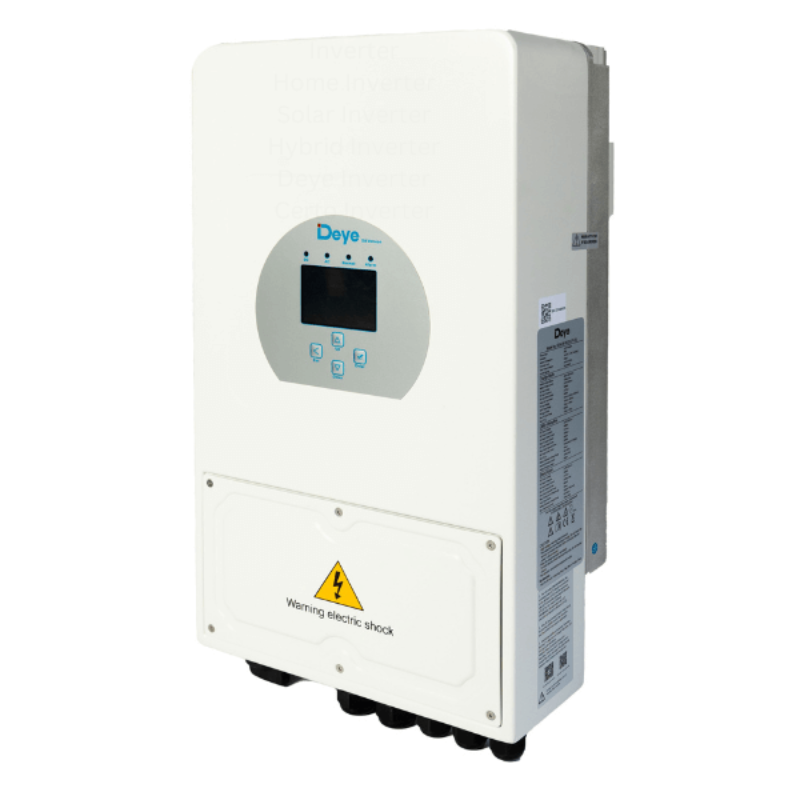
If you are planning to install solar power or improve your home’s power backup, a hybrid inverter is one of the most important components to consider.
Deye hybrid inverters are designed to work with solar panels, battery storage and grid electricity, depending on the model and system configuration. They can be used in residential and commercial installations where customers want to make use of solar energy while maintaining backup power.
But which Deye inverter should you buy? Is a 5kW model enough for your home? Should you choose a 6kW, 8kW or 12kW inverter? And which battery will work with your system?
At Happy Solar Systems, we supply solar power equipment, including inverters, batteries, solar panels and accessories. This guide explains what to consider before choosing a Deye hybrid inverter in Kenya.
If your main priority is reliable electricity during outages, start with our Power Backup Solutions in Kenya – Happy Solar Systems page for an overview of backup system options.
1. What Is a Deye Hybrid Inverter?
A hybrid inverter manages electricity from different sources, typically solar panels, a battery and the grid.
During the day, solar panels can supply electricity to connected appliances. If solar production exceeds immediate demand, a compatible system can use the surplus to charge the battery or export electricity where the system and local arrangements permit.
When solar production is insufficient, the system may draw energy from the battery or grid, depending on its configuration and settings.
During a power outage, a Deye hybrid inverter with the appropriate backup functionality can supply designated loads using available solar energy and battery storage.
The exact features depend on the inverter model. Not every model has the same battery voltage, output rating, backup capacity or three-phase capability.
A hybrid inverter is therefore worth considering if you want to combine solar generation with battery storage rather than relying on a basic inverter and battery setup alone.
2. Deye Hybrid Inverter Prices in Kenya
The price of a Deye hybrid inverter in Kenya depends on its rated power, phase configuration, model generation, battery voltage, features and current supplier stock.
Larger inverters generally cost more because they are designed to handle higher power demands, but choosing the largest model is not always necessary.
The following table shows example price points for Deye inverter capacities previously listed by Happy Solar Systems. These are indicative reference prices, not a confirmed current quotation. Please confirm the exact model, specifications and availability before purchasing.
| Deye inverter capacity | Indicative reference price |
|---|---|
| 5kW | KSh 105,000 |
| 6kW | KSh 110,000 |
| 8kW | KSh 145,000 |
| 12kW single-phase | KSh 225,000 |
| 12kW three-phase | KSh 240,000 |
Prices may change and may not apply to every Deye model within a capacity range. Confirm whether the quoted price covers the inverter only or includes batteries, solar panels, protection equipment and installation.
A complete solar installation will normally cost more than the inverter alone because it may also require batteries, solar panels, mounting structures, cables, breakers and labour.
For help planning the complete installation, visit Power Backup Solutions in Kenya.
3. Which Deye Inverter Size Is Best for Your Home?
The correct inverter size depends on the power your appliances require at the same time, the appliances’ starting currents and whether you want to supply essential circuits or a larger portion of the property.
Here is a general guide to choosing a capacity.
Deye 5kW hybrid inverter
A 5kW inverter may suit a home with moderate electricity requirements, provided the combined load and starting demand remain within its specifications.
It may be considered for selected lighting, televisions, computers, refrigeration and other suitable household appliances.
However, the number of appliances you can run depends on their actual power ratings. High-power appliances such as electric cookers, kettles, water heaters and pumps can use a substantial part of the available capacity.
Deye 6kW hybrid inverter
A 6kW model may offer additional capacity for households with a higher combined load.
It can be worth considering if your appliance requirements exceed what a smaller inverter can comfortably handle. You should still calculate the expected simultaneous load before choosing the system.
Deye 8kW hybrid inverter
An 8kW inverter may suit a larger household or a property with greater power requirements.
Before selecting it, check the exact model’s output rating, surge capabilities, battery requirements and supported solar input. A larger inverter may also require a battery bank capable of supplying the corresponding power.
Deye 12kW hybrid inverter
A 12kW model may suit larger homes or certain commercial installations, depending on the model and phase configuration.
It is important to distinguish between single-phase and three-phase models. The correct option depends on the property’s electrical supply and the equipment that needs to operate.
Do not assume that a three-phase inverter is suitable for every property or that all 12kW models have identical features.
The practical approach: List your appliances, identify which ones must run together and determine your expected backup duration before choosing the inverter.
4. Deye Single-Phase vs Three-Phase Inverters
This is an important consideration for customers choosing larger solar systems.
A single-phase inverter is designed for a compatible single-phase electrical installation. A three-phase inverter is intended for an appropriate three-phase installation and has different electrical characteristics.
| Feature | Single-phase inverter | Three-phase inverter |
|---|---|---|
| Electrical supply | Compatible single-phase installation | Compatible three-phase installation |
| Typical applications | Many homes and smaller properties | Properties with three-phase supplies and larger or distributed loads |
| Appliance compatibility | Depends on the inverter and connected circuits | Depends on phase allocation and inverter design |
| Installation requirements | Must match the property’s electrical system | Requires appropriate three-phase design and configuration |
If your home or business has a three-phase supply, the inverter must be selected according to the loads on each phase and the manufacturer’s specifications.
Some systems support particular configurations for balancing or supplying loads across phases, but this should never be assumed without checking the exact model.
Ask a qualified installer to assess your electrical supply before purchasing a three-phase inverter.
5. Which Battery Works With a Deye Hybrid Inverter?
Battery compatibility is one of the most important things to confirm before buying a Deye inverter.
Deye offers different inverter models with different battery requirements. Some models use low-voltage batteries, while others are designed for high-voltage battery systems.
A battery that works with one Deye inverter will not necessarily work with every other model.
Before purchasing, check the following:
- Battery voltage: Confirm that the battery system matches the inverter’s supported voltage range.
- Battery chemistry: Check that the inverter supports the battery type you intend to use.
- Communication: Confirm whether CAN, RS485 or another supported communication method is required.
- Charge and discharge limits: Make sure the battery can support the current and power required by the inverter.
- Approved compatibility: Check the inverter manufacturer’s battery compatibility information for the exact models.
- Expansion requirements: If you plan to add more batteries later, confirm the permitted battery configuration.
Lithium iron phosphate (LiFePO4) batteries are commonly used in modern solar storage systems. They can be a suitable option when the battery and inverter are designed to work together.
Do not choose a battery based on its capacity alone. The voltage, discharge capability and communication requirements are equally important.
For a wider overview of inverter and battery combinations, see our Power Backup Solutions in Kenya page.
6. How Many Solar Panels Do You Need for a Deye Inverter?
The number of solar panels depends on the inverter’s supported solar input, the wattage of each panel, your daily electricity consumption and the available roof or ground space.
For example, if you were planning around 550W solar panels, a simple arithmetic calculation would give:
- 8 panels × 550W = 4.4kW of panel capacity.
- 10 panels × 550W = 5.5kW of panel capacity.
- 12 panels × 550W = 6.6kW of panel capacity.
These figures represent the combined rated power of the panels, not the guaranteed energy produced each day.
Actual solar generation depends on sunlight, orientation, shading, temperature, system losses and other installation conditions.
You must also check the inverter’s maximum PV input power, maximum DC voltage, operating voltage range, current limits and MPPT specifications. The panels must be arranged into strings that stay within the manufacturer’s electrical limits.
Do not select the panel count based only on the inverter’s kW rating. The solar array must be designed to suit the exact inverter model and site conditions.
7. Can a Deye Hybrid Inverter Work Without Solar Panels?
A compatible hybrid inverter may be able to charge its battery from the grid and provide backup power without solar panels, depending on the model and its configuration.
This can be useful if you want to install an inverter and battery first, then add solar panels later.
However, not every model has identical operating modes or charging features. Check the manufacturer’s documentation to confirm the intended configuration.
If you plan to add solar panels in the future, make sure the initial equipment supports the upgrade. It is also worth considering whether your existing battery capacity will be sufficient for the expected backup period.
This staged approach can spread the cost of a solar installation, but compatibility should be confirmed before buying.
8. How Long Will a Battery Last With a Deye Inverter?
The inverter does not determine battery runtime on its own. Runtime depends mainly on the battery’s usable energy, the connected load and the efficiency of the system.
For a simple illustration, assume a battery has 5kWh of rated energy, 4.5kWh of usable energy and the inverter operates at an assumed 90% efficiency.
The estimated energy available to appliances would be:
4.5kWh × 0.90 = 4.05kWh.
If the connected appliances draw an average of 500W, or 0.5kW, the estimated runtime would be:
4.05kWh ÷ 0.5kW = 8.1 hours.
This is a simplified estimate. Actual runtime depends on battery specifications, inverter consumption, temperature, operating limits and changes in the load.
If the household uses more appliances, the battery will run down more quickly. If it uses fewer appliances, the available energy may last longer.
This is why the inverter and battery should be sized together rather than selected independently.
9. Can a Deye Inverter Power an Entire House?
It may be possible, but the answer depends on the property’s maximum demand, electrical configuration and backup requirements.
A household may have many appliances connected, but they do not all necessarily run at full power simultaneously. A proper load assessment helps establish whether the inverter can handle the expected demand.
For some homes, backing up essential circuits is more practical than attempting to supply every appliance.
Essential circuits may include:
- Selected lights.
- Internet and communication equipment.
- Television and electronics.
- Refrigeration.
- Selected sockets.
- Other appliances identified as priorities.
High-power appliances such as electric showers, cookers, kettles, heaters and water pumps require particular attention.
If you want whole-home backup, the installer should assess the property’s supply, maximum load, circuit arrangement and the inverter’s backup capabilities.
10. Deye Hybrid Inverter vs a Standard Inverter
A standard inverter and battery setup may be suitable when the main goal is backup power.
A hybrid solar inverter can offer additional flexibility by managing solar generation, battery storage and grid electricity within the limits of the model.
| Feature | Standard backup inverter | Hybrid solar inverter |
|---|---|---|
| Battery backup | Depends on the model | Supported by suitable models |
| Solar panel connection | Depends on the model | Designed to support solar input |
| Grid charging | Available on compatible models | Available on compatible models |
| Solar energy management | May require separate equipment | Integrated into supported hybrid models |
| System expansion | Depends on the design | Depends on the model and configuration |
A hybrid inverter may be the better option if you plan to install solar panels and batteries as part of one coordinated system.
However, a hybrid inverter is not automatically the cheapest choice for every customer. If you only need a simple backup arrangement, compare the total cost and features of both options.
For more guidance, visit Happy Solar Systems’ Power Backup Solutions in Kenya.
11. Common Mistakes to Avoid When Buying a Deye Inverter
Choosing an inverter without calculating the load
The inverter must support the combined running power and starting requirements of the appliances you intend to use.
Buying an incompatible battery
Confirm the exact inverter and battery models before purchasing. Similar-looking products may have different voltage and communication requirements.
Ignoring the solar input limits
The panel array must remain within the inverter’s voltage, current and power limits. Incorrect string design can damage equipment or prevent the system from operating correctly.
Assuming every model provides the same backup features
Deye inverter models differ in output capacity, phase configuration, battery voltage and operating features. Check the specifications of the exact model.
Forgetting installation costs
A complete installation may require protection equipment, cables, mounting materials and labour in addition to the inverter and battery.
Buying more capacity than you need
A larger inverter may be appropriate for future expansion, but it should be selected based on a realistic assessment of your present and planned loads.
12. Where Can You Buy Deye Hybrid Inverters in Kenya?
If you are looking for Deye hybrid inverters in Kenya, start by identifying the capacity, phase configuration and battery arrangement that suit your installation.
Happy Solar Systems supplies solar power equipment, including inverters, batteries, solar panels and accessories.
When requesting a quotation, share your location, your existing electrical supply, the appliances you want to run and whether you already have solar panels or batteries.
If you have a preferred Deye model, include its exact model number so that the specifications and compatibility can be checked.
You can also browse our Power Backup Solutions in Kenya page to explore options for your home or business.
Request a quotation from Happy Solar Systems
Contact us to discuss your solar or power backup requirements.
- Phone / WhatsApp: +254 741 163020
- Email: info@happysolar.co.ke
- Website: www.happysolar.co.ke
Tell us the inverter capacity you are considering, your battery requirements and the appliances you need to power. This will help us identify suitable equipment options.
Frequently Asked Questions
How much does a Deye hybrid inverter cost in Kenya?
The price depends on the inverter’s capacity, model, phase configuration and current availability. Confirm the exact model and whether the quotation covers the inverter only or a complete installation.
Which Deye inverter is best for a home?
A 5kW, 6kW, 8kW or larger model may suit different homes. The correct choice depends on the connected load, starting power, electrical supply and backup requirements.
Can a Deye hybrid inverter use a lithium battery?
Compatible Deye models can work with supported lithium batteries. Confirm the battery voltage, communication requirements and manufacturer-approved compatibility for the exact models.
Can a Deye inverter work during a power cut?
A model with the appropriate backup functionality can supply supported loads during an outage when suitable energy is available from batteries or solar generation. The system must be configured correctly.
How many solar panels can I connect to a Deye inverter?
The number depends on the exact inverter model, panel specifications, PV input limits and string design. Have the array designed according to the manufacturer’s electrical requirements.
Should I buy a Deye single-phase or three-phase inverter?
Choose a model that matches your property’s electrical supply and load arrangement. A qualified installer should confirm which configuration is appropriate.
Where can I enquire about Deye inverters in Kenya?
Visit Happy Solar Systems or our Power Backup Solutions in Kenya page to enquire about suitable solar and backup equipment.


