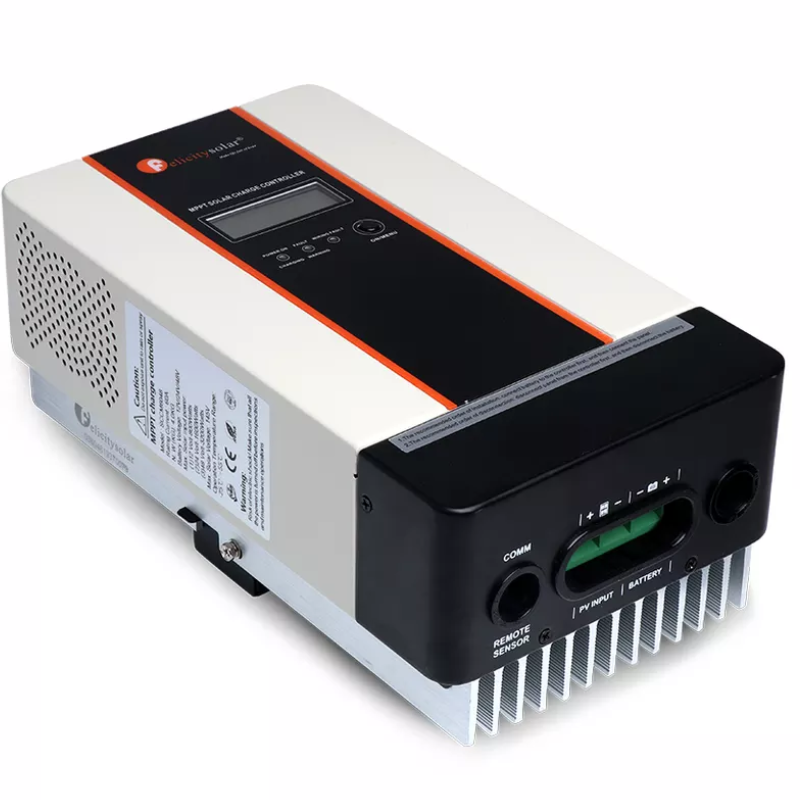
If you’re building or upgrading a solar system and keep seeing “MPPT” and “PWM” on every controller listing with no real explanation of the difference, you’re not alone — it’s one of the most-searched solar component questions in Kenya, and most listings just assume you already know. Here’s the plain version.
What a charge controller actually does
Whether MPPT or PWM, a charge controller’s basic job is the same: it sits between your solar panels and your battery, regulating how much current and voltage flows into the battery so it charges properly without being overcharged, over-discharged, or damaged by voltage spikes. Without one, you’re connecting panels directly to a battery with no protection — not something we’d ever recommend, regardless of system size.
PWM — the simpler, cheaper option
A PWM (Pulse Width Modulation) controller works by rapidly switching the connection between panel and battery on and off, which effectively pulls the panel’s voltage down to match the battery’s voltage. It’s a proven, well-understood technology, and PWM controllers are noticeably cheaper than MPPT — commonly found from around KSh 3,000–8,000 depending on amperage.
The trade-off: PWM only works efficiently when your panel’s voltage closely matches your battery’s voltage. If there’s a meaningful mismatch, you lose a real chunk of your panel’s potential output as wasted energy.
Want help figuring out whether PWM is sufficient for your specific small system? Call or WhatsApp us on +254 741 163020 and we’ll give you a straight answer, not just push the pricier option.
MPPT — the more efficient, more expensive option
An MPPT (Maximum Power Point Tracking) controller is smarter — it continuously tracks the optimal voltage and current combination from your panels and converts it efficiently to whatever your battery needs, even when there’s a significant voltage difference between panel and battery. This means it captures meaningfully more of your panels’ potential output.
MPPT controllers typically run 20–30% more efficient than PWM in real-world conditions, particularly in cooler weather or cloudy conditions where the efficiency gap widens further. They’re more expensive — often KSh 10,000–25,000+ depending on amperage and brand — but for most serious installations, that efficiency gain pays for the price difference over time.
So which should you actually buy?
Go PWM if: you’re running a small, simple system where your panel voltage is already closely matched to your battery voltage (a basic 12V panel setup with a 12V battery, for instance), and budget is the primary constraint. PWM remains a perfectly legitimate choice for smaller setups — it’s not an inferior product, just a simpler one suited to simpler systems.
Go MPPT if: you’re running anything beyond a small basic setup — a full home hybrid or off-grid system, any setup where panel and battery voltages differ meaningfully, or any installation where you want to extract the most value from your panel investment. For most of the systems we install, MPPT is the sensible default.
Not sure which category your setup falls into? Send us your panel and battery specs on WhatsApp — +254 741 163020 — and we’ll tell you which controller type actually fits, PWM or MPPT.
A quick way to tell if you need to upgrade
If you currently have a PWM controller and suspect you’re not getting full value from your panels, a simple sign to watch for: your system seems to underperform noticeably on cooler or slightly overcast days compared to what the panel’s rating would suggest. That’s often a sign of PWM voltage mismatch losses, which an MPPT upgrade would recover.
What to check before buying any controller, MPPT or PWM
- Amperage rating — make sure it comfortably exceeds your panel array’s actual output current, with some headroom, not a tight match.
- Voltage compatibility — confirm it supports your system voltage (12V, 24V, or 48V) and your panel’s open-circuit voltage.
- Battery compatibility — make sure it supports your specific battery chemistry (lithium settings differ from lead-acid/gel), since using the wrong charging profile can shorten battery life.
- Genuine stock — as with inverters and panels, buy through an authorised dealer. A controller is a small part of your system’s cost but plays a big role in protecting the expensive part — your battery.
Browse our charge controllers or call +254 741 163020 — we stock both PWM and MPPT options and can match the right one to your exact panel and battery setup rather than just sell you whichever’s in stock.