
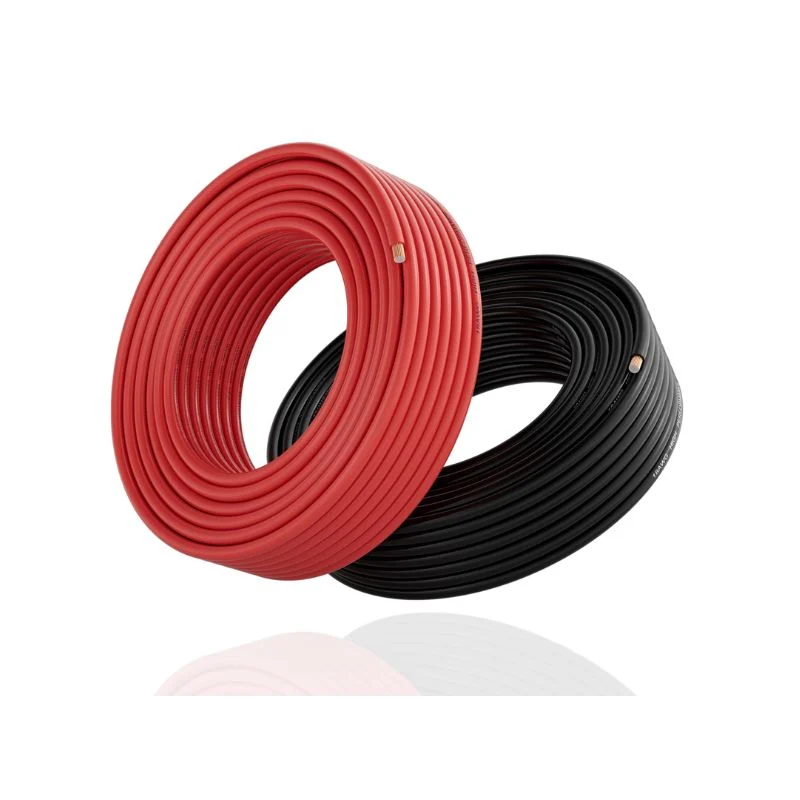
Cable is the part of a solar system almost nobody thinks about until something goes wrong — and when it does go wrong, it’s often because the wrong cable size was used to save a small amount of money upfront. Here’s what you actually need to know before buying.
Why cable size matters more than people assume
Every cable has resistance, and resistance causes voltage drop and heat as current flows through it — the longer the run and the higher the current, the more this matters. Undersized cable on a solar run doesn’t just lose you efficiency through voltage drop (meaning less power actually reaching your battery or inverter than your panels generated); in worse cases, it can overheat, which is a genuine fire risk, not a theoretical one.
This is one of the areas where buying the cheapest option available is a false economy. The cable itself is a relatively small part of your total system cost — getting it wrong risks the far more expensive components around it.
Not sure what cable size your specific system needs? Send us your panel wattage, battery voltage, and roughly how far the run is — call or WhatsApp +254 741 163020 — and we’ll tell you the right gauge.
DC cable vs AC cable — not interchangeable
DC (solar) cable runs between your panels and your charge controller or inverter, and between your battery and inverter. It’s typically double-insulated, UV-resistant (since much of this run is exposed outdoors on the roof), and rated for the specific voltage and current your DC circuit carries.
AC cable runs from your inverter’s output to your home’s consumer unit and wiring — standard household electrical cable, sized according to normal electrical wiring standards for the load it carries.
Using standard indoor cable for an outdoor DC panel run is a common cost-cutting mistake — it’s not UV-rated, degrades faster in direct sun, and isn’t built for the specific demands of a DC solar circuit.
How cable size (gauge) is actually chosen
Three things determine the right cable size: the current it will carry (amps), the length of the run, and the acceptable voltage drop (generally aimed to be kept under about 2–3% for solar runs, to avoid meaningfully losing generated power before it reaches the battery). A longer run or higher current both push you toward a thicker cable, measured in mm² here in Kenya rather than the AWG gauge system used in some other countries.
As a rough guide (always confirm with an actual calculation for your specific run): shorter panel-to-controller runs on smaller systems might use 4mm² or 6mm² cable, while larger systems or longer runs often step up to 10mm² or higher. This isn’t a one-size figure — it genuinely depends on your specific current and distance, which is why a proper calculation matters more than a generic rule of thumb.
Rather not guess at this? Tell us your system size and approximate cable run length — email info@happysolar.co.ke or WhatsApp +254 741 163020 — and we’ll confirm the correct gauge before you buy.
What to look for when buying
- Proper UV and weather rating for any outdoor DC cable — check the specification explicitly, don’t assume.
- Correct voltage rating for your system (most solar DC cable is rated well above typical system voltages, but it’s worth confirming, especially for larger commercial systems).
- Genuine copper conductor, not copper-clad aluminum sold at a lower price — this is a common place for cost-cutting that genuinely affects performance and safety, and it’s not always obvious from the outside.
- Double insulation for DC cable specifically, which protects against a fault in one conductor creating a dangerous short.
MC4 connectors — the other half of the DC cable conversation
Your panel cables terminate in MC4 connectors, the standard snap-fit connectors used across the solar industry. We’ve covered these properly in a separate guide, since fake or poor-quality MC4 connectors are a surprisingly common source of connection failures and water ingress at the panel end of the circuit.
A mistake worth avoiding entirely: reusing old or unrated cable
We occasionally see clients wanting to repurpose general household electrical cable they already have on hand for a panel run, to save money. We’d always advise against this — general household cable isn’t built for outdoor UV exposure or the specific demands of a DC solar circuit, and the cost difference versus proper solar cable is small relative to the risk.
Where to get it right
If you’re buying components for a DIY installation or topping up an existing system, get in touch or call +254 741 163020 with your system details, and we’ll confirm the correct cable type and size before you buy — it’s a quick conversation that avoids a genuinely expensive mistake down the line.