
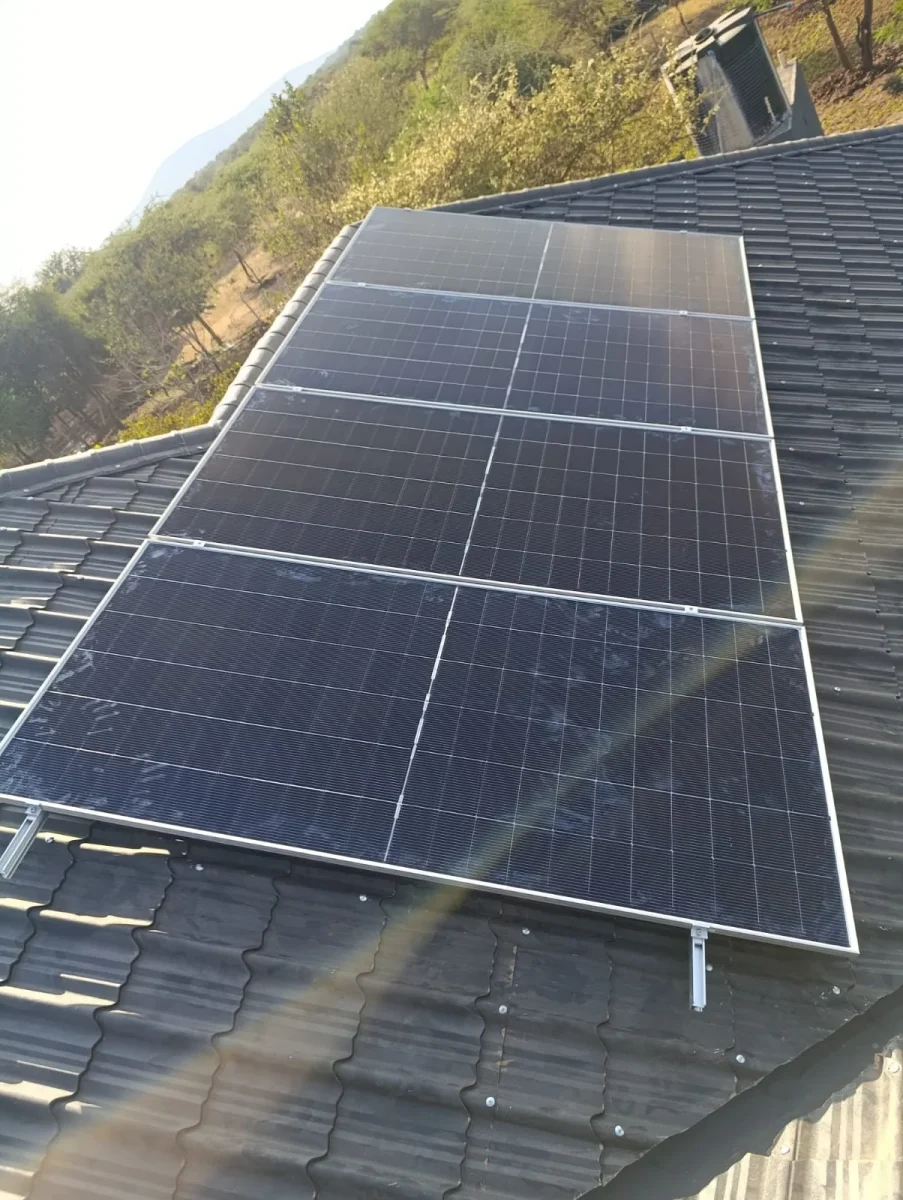
If you have started looking at solar for your home, you have probably noticed that there are many different solar panels in Kenya.
One supplier tells you to buy Jinko. Another recommends JA Solar. Someone else says Canadian Solar is the one to go for. Then you see panels marked 450W, 550W, 575W, 585W, 600W or even higher and start wondering, “Which one do I actually need?”
It can get confusing very quickly.
And honestly, we understand why. When you are spending money on a solar system, you don’t want someone to simply give you a quotation and tell you, “These are the best panels.” You want to know what you are paying for and why.
At Happy Solar Systems, we deal with customers who have very different needs. Some want a small solar system for lights and basic backup. Others want enough solar to run a full family home. We also work with farms, offices, shops and businesses where the electricity demand is much higher.
So let’s make this simple.
Happy Solar Systems
Call / WhatsApp: +254 741 163020
Email: info@happysolar.co.ke
Ridgeways, Kiambu Road, Nairobi
How Much Do Solar Panels Cost in Kenya?
This is usually the first question.
“How much is a solar panel in Kenya?”
The answer depends mainly on the panel’s wattage, technology, brand, availability and the quantity you are buying.
A 450W panel will obviously not cost the same as a 585W or 650W panel. The price also changes as manufacturers introduce newer technologies and as international shipping and exchange rates move.
So when somebody gives you a price for a solar panel, don’t only ask, “How much?”
Ask:
“Which brand? Which model? How many watts? Is it N-type or P-type? Is it monocrystalline? What is the warranty? And how many panels do I need?”
Those questions give you a much clearer picture.
At Happy Solar Systems, we supply solar panels together with the other equipment needed to build a complete solar system, including inverters, batteries and solar accessories.
Happy Solar Systems
+254 741 163020 | info@happysolar.co.ke
Why Solar Panel Prices Keep Changing
Solar equipment prices don’t remain fixed forever.
Stock comes in at different times, manufacturers update their product ranges and exchange rates can affect the landed cost of equipment. That’s why you may see one price online today and a different price when you call a supplier a few weeks later.
There is also a big difference between a panel price and the price of a complete solar installation.
You still need mounting rails, clamps, solar cables, connectors, protection equipment and installation. If you are installing a hybrid system, you also need the inverter and battery.
So if someone tells you, “A 5kW solar system only costs the price of ten panels,” something is missing from the conversation.
Happy Solar Systems
Call / WhatsApp: +254 741 163020
Email: info@happysolar.co.ke
550W Solar Panels in Kenya
550W solar panels are a popular size for residential and commercial solar installations.
The idea is quite simple. The more watts each panel produces, the fewer panels you may need to reach a particular total system size.
For example, ten 550W panels give you a total rated capacity of 5.5kW under the panel’s standard test conditions.
That doesn’t mean the panels will produce exactly 5.5kW every moment of the day. Real-world production depends on sunlight, temperature, orientation, shading, dirt and other installation conditions.
JA Solar’s current 550W module documentation, for example, lists a 550W version in its JAT60S40 LR series, with a maximum power voltage of 36.73V and maximum power current of 11.29A under its published STC specifications.
Happy Solar Systems
+254 741 163020 | info@happysolar.co.ke
585W Solar Panels in Kenya
The 585W solar panel is another size you will see quite often in Kenya.
We currently use 585W Jinko panels in some of our residential solar packages at Happy Solar Systems. For example, our current Family Package uses four 585W Jinko panels with a 5kW Deye hybrid inverter and a 5kWh Lithium Valley battery.
Our Standard Package uses eight 585W Jinko panels.
Why use panels this size?
Because you can get a good amount of solar generation from a relatively manageable number of panels.
Jinko’s published Tiger Neo 565–585W documentation describes N-type technology, positive power tolerance of 0 to +3% and features including multi-busbar technology, Hot 2.0 technology and PID resistance.
Happy Solar Systems
Call / WhatsApp: +254 741 163020
Email: info@happysolar.co.ke
Jinko Solar Panels in Kenya
If you have been shopping around for solar panels in Kenya, there is a good chance someone has mentioned Jinko Solar.
Jinko has a large range of panels, and the exact specifications depend on the series and model.
Its current Tiger Neo range uses N-type TOPCon technology, while newer Tiger Neo products have moved to even higher wattages. Jinko currently lists Tiger Neo products reaching 650W and above, depending on the particular series.
But here’s something important.
Don’t assume that a panel with a higher wattage is automatically the right panel for your roof.
A 650W panel may produce more power per panel, but it can also be physically larger. If you have a small roof with awkward sections, the panel dimensions and layout may matter just as much as the wattage.
This is why we normally look at the roof space before deciding what panels to use.
Happy Solar Systems
+254 741 163020 | info@happysolar.co.ke
JA Solar Panels in Kenya
JA Solar is another major manufacturer you will find in the Kenyan solar market.
Its product range includes high-wattage monocrystalline modules, including current 550W-class products. JA Solar’s published 550W JAT60S40 LR specification lists a maximum system voltage of 1500V DC and a maximum series fuse rating of 25A.
When customers ask us about JA Solar, we normally bring the conversation back to the actual system.
Are you building a 5kW home system?
A 10kW business system?
A solar pump?
An off-grid farm system?
The answer affects how we arrange the panels and what inverter we pair them with.
The panel is one part of the system. It shouldn’t be selected in isolation.
Happy Solar Systems
Call / WhatsApp: +254 741 163020
Email: info@happysolar.co.ke
Canadian Solar Panels in Kenya
Canadian Solar is another established solar module manufacturer with a broad product range.
Its HiKu6 series, for example, has included modules from 535W through 555W, with the manufacturer’s published specifications showing up to 21.5% module efficiency for the listed series. Canadian Solar also publishes a 25-year linear power performance warranty for that product family.
Canadian Solar’s current catalogue has also moved into newer N-type TOPCon and HJT products with substantially higher wattages.
Again, the exact model matters.
If somebody quotes you “Canadian Solar 550W,” ask for the full model number. That’s how you make a proper comparison.
Happy Solar Systems
+254 741 163020 | info@happysolar.co.ke
Jinko vs JA Solar vs Canadian Solar
This is where customers often want us to simply say, “Buy this one.”
But we prefer to look at the actual specifications.
All three manufacturers have multiple product families. A Jinko panel from one series may have different characteristics from another Jinko panel. The same applies to JA Solar and Canadian Solar.
| Feature | Jinko | JA Solar | Canadian Solar |
|---|---|---|---|
| High-wattage panels | Yes | Yes | Yes |
| N-type/TOPCon products | Yes | Yes | Yes |
| Residential applications | Yes | Yes | Yes |
| Commercial applications | Yes | Yes | Yes |
| Bifacial options | Yes | Yes | Yes |
| Different panel sizes | Yes | Yes | Yes |
| Product specifications | Model dependent | Model dependent | Model dependent |
So instead of asking us, “Which brand is the best?”, give us the exact three models you are comparing.
Then we can look at the wattage, efficiency, dimensions, current, voltage, warranty and compatibility with your inverter.
That gives you a much more useful comparison.
Happy Solar Systems
Call / WhatsApp: +254 741 163020
Email: info@happysolar.co.ke
How Many Solar Panels Does a House Need?
This is another question we get all the time.
“I have a three-bedroom house. How many panels do I need?”
Unfortunately, the number of bedrooms doesn’t tell us much about your electricity consumption.
You could have a three-bedroom house with only a fridge, lights, TV and Wi-Fi.
Or you could have a three-bedroom house with an electric cooker, water heater, borehole pump, washing machine, several fridges, microwave, iron, air conditioner and other heavy appliances.
Those houses are going to need very different solar systems.
So instead of counting bedrooms, start by looking at your electricity consumption.
Your monthly KPLC bill gives us a useful starting point. We can also look at the appliances you have and when you normally use them.
Happy Solar Systems
+254 741 163020 | info@happysolar.co.ke
Solar Panels for a 5kW System
Let’s take a common example.
Suppose you want a 5kW solar system.
You don’t necessarily need exactly 5kW of panels.
For example, ten 550W panels give you 5.5kW of rated solar capacity. Nine 585W panels give you 5.265kW. Eight 585W panels give you 4.68kW.
The actual configuration depends on the inverter’s PV input limits, MPPT voltage range, maximum current and the physical space available.
This is why we don’t simply say, “Buy ten panels because you have a 5kW inverter.”
The inverter specification needs to be checked first.
Happy Solar Systems
Call / WhatsApp: +254 741 163020
Email: info@happysolar.co.ke
Solar Panels for a 10kW System
A 10kW solar system gives you more room to generate electricity, but once again, the panel count depends on the panel wattage.
For example:
| Panel size | 10 panels | 15 panels | 20 panels |
|---|---|---|---|
| 450W | 4.5kW | 6.75kW | 9kW |
| 550W | 5.5kW | 8.25kW | 11kW |
| 585W | 5.85kW | 8.775kW | 11.7kW |
| 600W | 6kW | 9kW | 12kW |
These are simply the combined panel ratings.
They do not tell you the exact amount of electricity you will generate each day.
The roof orientation, shading, temperature and other site conditions matter.
Happy Solar Systems
+254 741 163020 | info@happysolar.co.ke
Solar Panels for Businesses and Farms
Businesses often have a very different electricity pattern from homes.
A shop might consume electricity mostly during the day. An office may have computers, lighting, networking equipment and air conditioning running from morning to evening.
A farm may have pumps, refrigeration, electric fencing, irrigation equipment and other loads.
That makes solar particularly interesting because the system can be designed around the hours when electricity is actually being consumed.
For a business, we normally want to look at your electricity bills over several months rather than designing the system from one month’s bill.
For farms, we also need to understand the pump size, operating hours and whether the system needs battery backup or can operate mainly during daylight hours.
Happy Solar Systems
Call / WhatsApp: +254 741 163020
Email: info@happysolar.co.ke
N-Type TOPCon Solar Panels
You will hear the term N-type TOPCon quite a lot when shopping for modern solar panels.
You don’t need to be an electrical engineer to understand the basic idea.
N-type TOPCon is a solar-cell technology used in many newer high-efficiency panels. Jinko’s current Tiger Neo range, for example, is based on N-type TOPCon technology and highlights improved temperature performance, low-light performance and reduced degradation characteristics.
This matters in Kenya because solar panels spend a lot of time operating in warm conditions.
Jinko publishes a temperature coefficient of around -0.29%/°C for its current Tiger Neo technology, while its product information highlights low-light performance and resistance to degradation mechanisms such as LID and LETID.
But again, don’t buy a panel just because the box says “TOPCon.”
Look at the complete specification.
Happy Solar Systems
+254 741 163020 | info@happysolar.co.ke
Solar Panels and Heat in Kenya
Solar panels need sunlight, but they don’t particularly enjoy excessive heat.
This sounds strange at first.
You might think, “Surely the hotter the panel, the more electricity it produces?”
Not exactly.
Solar panels are tested under standard conditions, and their electrical output changes as the cell temperature rises. Manufacturers therefore publish temperature coefficients to show how power changes with temperature.
That is one reason modern panel specifications include temperature-coefficient information.
It is also one reason proper installation matters. The panels should have appropriate mounting and ventilation rather than simply being placed directly against a roof surface without consideration for airflow.
Happy Solar Systems
Call / WhatsApp: +254 741 163020
Email: info@happysolar.co.ke
Solar Panel Installation in Kenya
Buying good solar panels is only half the job.
The installation also matters.
The panels need to be mounted securely, cables need to be correctly sized and protected, connectors need to be properly fitted, and the panel strings need to be configured according to the inverter’s electrical limits.
Canadian Solar’s installation documentation, for example, specifies different clamp positions and mounting arrangements depending on the installation configuration and load requirements.
This is not an area where you want someone to say, “Don’t worry, we’ll figure it out on site.”
A proper installation should be planned before the panels arrive.
Happy Solar Systems
+254 741 163020 | info@happysolar.co.ke
Don’t Forget the Solar Accessories
People spend a lot of time choosing panels and inverters and then forget about the smaller equipment.
You still need solar cables, MC4 connectors, mounting rails, clamps, isolators, surge protection and other protection equipment.
These things may look small on the quotation, but they are part of the system.
If you are looking for these items, you can see our current range here:
Solar Accessories – Happy Solar Systems
We would rather supply the complete system properly than have a customer buy the panels today and then start hunting around for the correct connectors and protection equipment later.
Happy Solar Systems
Call / WhatsApp: +254 741 163020
Email: info@happysolar.co.ke
What Solar Panel Should You Buy in Kenya?
If you are asking us this question, we would first ask you a few questions back.
How much electricity do you use?
What appliances do you want to run?
Do you need battery backup?
How much roof space do you have?
Do you have shading?
Are you installing solar for a home, business or farm?
Once we know those things, choosing the panel becomes much easier.
You may find that 550W panels make sense for your roof. Another customer may be better off with 585W panels. A large commercial installation may use a completely different high-wattage panel.
There isn’t one panel that makes sense for every customer.
Happy Solar Systems
+254 741 163020 | info@happysolar.co.ke
Where to Buy Solar Panels in Kenya
If you are looking for solar panels in Nairobi, Happy Solar Systems supplies solar panels for residential, commercial and off-grid applications.
We can also supply the rest of the system, including:
- Solar inverters
- Lithium batteries
- Solar cables
- MC4 connectors
- Mounting systems
- Protection equipment
- Complete solar systems
View Solar Panels at Happy Solar Systems
If you’re not sure how many panels you need, don’t worry about trying to calculate everything yourself.
Send us your electricity bill, tell us what you want to power and, if possible, send us a list of your major appliances.
We’ll take it from there.
Happy Solar Systems
Call / WhatsApp: +254 741 163020
Email: info@happysolar.co.ke
Ridgeways, Kiambu Road, Nairobi
Conclusion
There are plenty of good solar panels available in Kenya today.
Jinko, JA Solar and Canadian Solar all have different product ranges, and each manufacturer offers panels with different wattages, technologies and specifications. Jinko’s current range includes N-type TOPCon Tiger Neo products, JA Solar has current 550W-class modules, and Canadian Solar has both established HiKu products and newer N-type technologies.
But when you’re buying solar for your home, don’t get too caught up in the brand name.
Start with what you actually need the solar system to do.
If you want to reduce your electricity bill, the design will be different from someone who wants complete backup during blackouts. A farm running pumps has different requirements from an office. And a large home with electric cooking and water heating will need a different system from a small home running only essential appliances.
So before you buy 10 panels because someone told you that’s what you need, give us a call.
We can look at your electricity bill, appliances, available roof space and budget and help you work out a system that makes sense.
Happy Solar Systems
Call / WhatsApp: +254 741 163020
Email: info@happysolar.co.ke
Ridgeways, Kiambu Road, Nairobi
Frequently Asked Questions
How much is a 550W solar panel in Kenya?
The price depends on the brand, exact model, stock and supplier. Always ask for the full model number and specification rather than comparing panels by wattage alone.
How many 585W panels do I need for a 5kW system?
The number depends on the inverter and system design. For example, eight 585W panels give a combined rated capacity of 4.68kW, while nine give 5.265kW. The inverter’s PV voltage and current limits must also be checked.
Are Jinko solar panels good for Kenya?
Jinko has a wide range of solar modules, including current N-type TOPCon products. The suitability of a particular Jinko panel depends on the exact model, system design and installation conditions.
Which is better: Jinko, JA Solar or Canadian Solar?
Rather than choosing by brand alone, compare the exact panel models based on wattage, efficiency, dimensions, voltage, current, temperature coefficient, warranty and compatibility with the inverter.
Can I use solar panels without a battery?
Yes. A solar system can be designed without battery storage, depending on the application. If you want electricity available during a grid blackout, however, the system needs an appropriate backup arrangement, normally involving energy storage.


