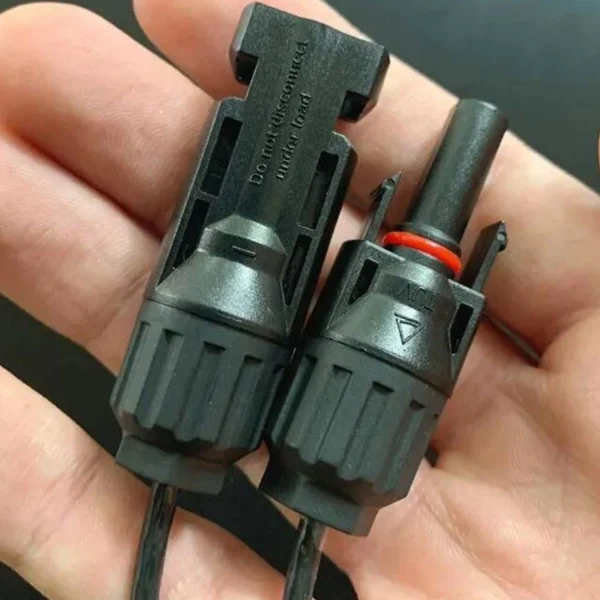
MC4 connectors are the small, cylindrical, snap-together plugs on the end of your solar panel cables — easy to overlook because they’re small and cheap relative to the rest of your system, but genuinely important to get right. Here’s what they actually do and what to watch for when buying.
What MC4 connectors actually do
They’re the industry-standard connector for joining solar panel cables to each other and to the rest of your DC circuit, designed specifically to be weatherproof, UV-resistant, and to carry DC current safely outdoors for years without maintenance. “MC4” simply refers to the standard connector type — nearly every solar panel manufactured today ships with MC4 connectors already attached, and nearly every solar cable and accessory is designed to be compatible with them.
They’re built to snap together securely and lock in place, specifically so they can’t be accidentally pulled apart by wind, vibration, or routine roof maintenance — and specifically so they can’t be separated while carrying a live current, which matters for safety during any future maintenance work.
Setting up panels yourself and not sure if your connectors are compatible with your cable and inverter? Call or WhatsApp us on +254 741 163020 and we’ll confirm before you buy anything.
Why a fake or poor-quality MC4 connector is a real problem
A genuine MC4 connector is weatherproof — properly sealed against rain, dust, and humidity over years of outdoor exposure, with a locking mechanism rated for the current it will carry. A cheap counterfeit often looks nearly identical on the outside but uses thinner internal contacts, lower-grade plastic that degrades faster under UV exposure, and seals that don’t hold up as well against water ingress over time.
The failure mode here isn’t always dramatic — it’s often a slow one. A degraded connector lets in a small amount of moisture over months or years, corrosion builds up on the internal contact, resistance increases, and the connection point heats up under load. In the worst cases, this leads to arcing — a genuine fire risk at a connection point that’s sitting directly against your roof.
How to tell a genuine connector from a questionable one
Check the branding. Genuine MC4 connectors (the name actually refers to Stäubli’s original design, now widely licensed and manufactured to the same open standard by reputable manufacturers) typically carry clear manufacturer markings. An unbranded connector with no markings at all is worth questioning.
Feel the locking mechanism. A genuine connector snaps together with a firm, confident click and resists being pulled apart by hand without using the proper release tool. A loose, wobbly connection, or one that separates too easily, is a red flag.
Check the price against the rest of the market. MC4 connectors aren’t expensive items individually, but if a price seems unusually low compared to what reputable solar suppliers charge, that’s often a sign of corner-cutting in materials.
Buy from your panel supplier or an established solar retailer, rather than a generic hardware or electronics shop with no specific solar specialisation — this is one of those small components where the seller’s specialisation genuinely matters.
Want us to check whether the connectors on an existing installation (yours, or one you’re buying into) are genuine? Email a photo to info@happysolar.co.ke or WhatsApp +254 741 163020 and we’ll take a look.
A quick note on installation
Even a genuine MC4 connector needs to be properly crimped and connected during installation — a correctly made connector assembled poorly can still fail. If you’re not confident doing this yourself, it’s one of the smaller jobs worth having a licensed technician handle, given what’s actually at stake if it’s done badly.
The bottom line
MC4 connectors are a small, inexpensive part of your overall system — which is exactly why cutting corners on them doesn’t make financial sense. The money saved buying a cheap or fake connector is small. The potential cost of a failed connection — lost generation, a damaged panel, or in the worst case a roof fire — is not.
Get in touch or call +254 741 163020 if you’re sourcing components for a DIY setup and want to make sure every part, connectors included, is genuine before it goes on your roof.